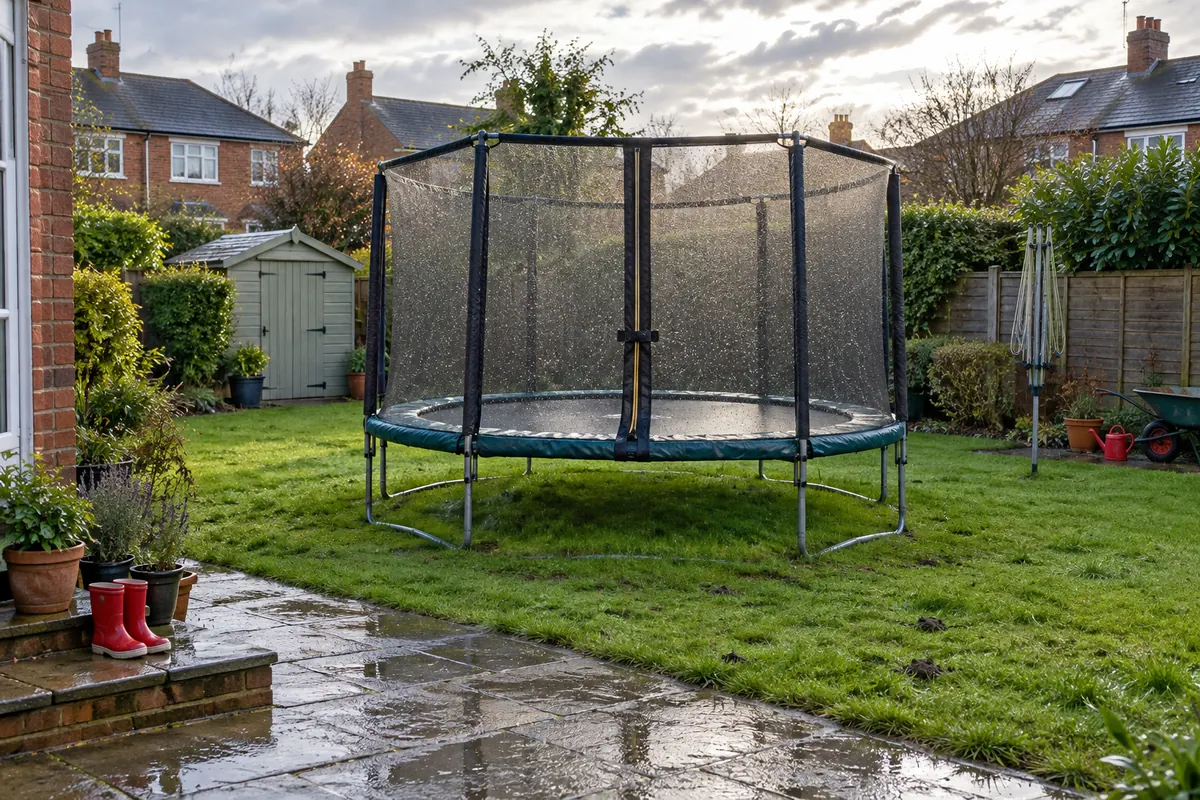
- RoSPA says children under six should not use full-size trampolines.
- One jumper at a time: user weights are never added up for several children.
- A stated user weight (150 kg on the SONGMICS 10ft, 100 kg on the HyperMotion 10ft) is not a static load or an in-house load test.
- Standards are the seller’s word: the Zero Gravity Ultima 4 and Bestway Xtreme Air 8ft listings state EN 71 compliance.
Trampoline safety rules from manuals and RoSPA
We read the rules printed in manufacturers’ manuals alongside the points RoSPA (the Royal Society for the Prevention of Accidents) makes on garden trampolines. They overlap closely; where your own manual is stricter, follow it.
| Rule | Source | In practice |
|---|---|---|
| One person on the trampoline at a time | Manuals and RoSPA | Others wait outside the net, not on the frame |
| Jumping under adult supervision | Manuals and RoSPA | An adult in the garden, watching, not indoors |
| No somersaults | Manuals and RoSPA | Save flips for a club with a coach |
| No shoes | Manuals | Shoes off before climbing in |
| Entrance zipped shut | Manuals | Zip and buckles closed once the jumper is in |
| Net and padding over springs and frame | RoSPA | Pad straps tied, net with no holes |
| Flat ground, clear space around and above | Manuals; RoSPA asks for a level, soft surface clear of hazards | Lawn rather than paving |
| Nothing and nobody underneath | Manuals | No toys, bikes, pets or children under the mat |
| Under-sixes off full-size trampolines | RoSPA | A small kids trampoline instead |
Trampoline safety by age and weight
Age limits come only from RoSPA and from each listing. Kids trampolines give their own: 12+ months for the TP Toys Early Fun, ages 3 to 6 for Radio Flyer and Happin, as our kids trampoline comparison shows. Zero Gravity says its Ultima 5 rectangular model is not for the very young.
| Model and size | Maximum user weight (stated) |
|---|---|
| SONGMICS 10ft | 150 kg |
| SONGMICS kids 8ft | 80 kg |
| HyperMotion 10ft | 100 kg |
| AWEV 14ft | 200 kg |
| Plum Play rectangular 8 x 6ft | 100 kg |
| Plum Play rectangular 10 x 8ft and 12 x 8ft | 120 kg |
Static load is not a user weight
Some listings print bigger figures beside the user weight. The SONGMICS 5.7ft gives 50 kg dynamic and 250 kg static; the Zupapa 4 x 6ft 300 kg static and 50 kg dynamic. Zero Gravity and Plum Play quote 500 kg in-house tests. Only the user weight tells you who may jump.
Where to put it: trampoline safety starts with the site
A trampoline goes on flat, level ground with clear space around and above it, as the manuals put it; RoSPA asks for a level, soft surface clear of hazards. Give the clearance your manual states, and size the frame to the garden with our what size trampoline guide.
- Away from fences, sheds, walls, greenhouses and paving.
- Clear of overhanging branches, washing lines and overhead cables.
- Nothing stored underneath, and no one crawling under while others jump.
- On a lawn rather than concrete or decking.

Wind and anchoring: trampoline safety in UK weather
UK gardens get strong gusts, and a garden trampoline can be lifted or moved by wind. Anchors come in the box with some models, according to their listings: the Kanga anchor kit, the Bestway Xtreme Air 8ft, MERACH, Yohood, four tent pegs with AWEV, and PlayActive from 12ft up.
For other sets, U pegs or screw-in anchors are sold separately; our guide to anchor kits and spares compares them. Zero Gravity’s cover listing warns that a cover acts as a sail in strong wind, so remove it or tie the frame down.
Follow your manual on removing the net, the cover or both. The Zero Gravity Ultima 4 lists a quick-release enclosure for this, as our Ultima 4 review explains.
 Payivsve screw-in anchor kit4.5/5 from 674 ratingsSee on Amazon
 ST Metals U pegs, pack of 44.6/5 from 1,000 ratingsSee on Amazon
Trampoline safety checks for springs, mat and net
A quick look before each session, plus a full check at the start of the season and after any storm, keeps worn parts from going unnoticed. If anything on this list fails, keep the trampoline out of use until the part is replaced.
The trampoline safety check before jumping
- Every spring in place and hooked at both ends.
- Pad lying flat over the springs, straps tied.
- Net zip and buckles working; no holes in the mesh.
- Nothing on the mat and nothing underneath.
A full trampoline safety check, part by part
| Part | Look for | Then |
|---|---|---|
| Springs | Stretched, rusted or missing springs, opened hooks | Replace with the same length |
| Mat | Tears, holes, loose stitching at the rings | Replace before use |
| Pad | Split cover, foam showing, broken straps | Re-tie or replace |
| Net and poles | Torn mesh, worn sleeves, bent poles, cracked foam | See our replacement nets |
| Frame and legs | Rust at joints, loose fixings | Tighten, or ask the maker |
| Anchors | Pegs lifted, straps frayed | Re-set or replace |
Trampoline safety claims on a listing
The European standard for domestic trampolines is EN 71-14, and a listing can only tell you that the seller states compliance with it. Read these lines as claims, then check the user weight and the age, which matter more day to day.
- EN 71 or EN 71-14: the sellers of Zero Gravity Ultima 4, Bestway Xtreme Air 8ft, Plum Play, HOMCOM 6FT, Zupapa, EXIT Silhouette and Salta state compliance.
- TÜV or GS: Devoko, AWEV, PlayActive, EVRE, EXIT and Salta, according to the seller.
- ASTM, a US standard: claimed on some toddler models.
- Words like ‘safety fortress’ or ‘certified-safe’ are the seller’s marketing, not a test result.

Trampoline safety in three common set-ups
Two children of 6 and 11
They take turns, even if their weights added up stay under the limit. The one waiting stands outside the net, and an adult stays in the garden.
A 9 m garden with a fence along one side
Place the frame towards the open side, with the manual’s clearance kept from the fence and the shed, and the entrance facing the house so the adult can see in.
Level the ground before building rather than packing up one leg; our step-by-step assembly guide covers the build on level ground.
Frequently asked questions
- Are trampolines dangerous?
They carry a risk of falls and collisions, which the manufacturers’ rules aim to reduce: one jumper, an adult watching, no somersaults, net closed. For a question about a particular child’s health, ask a GP or a physiotherapist.
- Does a net make a trampoline safe?
No net replaces supervision. RoSPA lists an enclosure net and padding over the springs and frame among its points, next to one jumper at a time and an adult watching.
- Can adults use a garden trampoline?
Yes, below the stated maximum user weight for that model and size, and one at a time like everyone else.
- Should the cover stay on between sessions?
It can, but it comes off before anyone jumps and in strong wind; our weather cover comparison has the fixings.
- How often does a trampoline need a full check?
At the start of each season and after storms, with a quick look before every session; your manual may set its own schedule.
Explore next: Trampoline assembly guideTrampoline parts guideWhat size trampoline to buy